Friday, May 16, 2014

RonnieAdventure #0100 - New Jersey, 2014 Part III

Since our hotel was located near the Edwin B. Forsythe National Wildlife Refuge (NWR), we stopped at the visitor’s center to watch an introductory movie and then drove the eight-mile Wildlife Drive through the wetlands tidal salt marsh. (More than 82% of the refuge is wetlands, of which about 78% is composed of a title salt marsh.) The 43,000 acres NWR was established in 1998 to protect and manage the coastal habitat for migratory birds, plants, and animals and now offers a variety of hiking trails, observation towers, and educational programs. We didn't climb the observation towers, but from the road you can observe a wide variety of ducks, geese, herons, falcons, and osprey that are part of the 322 different species of birds that have been recorded at the NWR.  


For lunch we stopped in Atlantic City at the world famous White House Sub Shop, which was featured on Dinners, Drive-ins and Dives. The Sub Shop has been in business for over 65 years and the walls are covered with signed pictures from many professional music and entertainment artists that have stopped by the Sub Shop while visiting or performing in Atlantic City. (Don’t tell my cardiologist, but the Philly Cheese Steak sandwich was great and highly recommended!)


While in Atlantic City, we also had ice cream on the Boardwalk and stopped by the Absecon Lighthouse. The Absecon Lighthouse is the tallest lighthouse in New Jersey and the 1857 Fresnel lens is still in place. The entire property is currently going through a $3.4 million restoration projects, which includes constructing a replica of the lightkeeper's dwelling and an educational museum. Just down the road in Margate, is Lucy the Elephant, the only 65-foot tall elephant in the world where you can stop and purchase souvenirs. (At 135 years old, Lucy is America's oldest roadside attraction and a National Historic Landmark.) If you are there at the right time, you can even get a tour of Lucy's internal structure!


We decided to made a side trip to Millville, so that we could visit Wheaton Arts (formerly known as Wheaton Village), and were fortunate that they were having a large celebration that day with many displays and working artists. Wheaton Arts is located on 65 acres of land and is also the location of the Museum of American Glass, the Creative Glass Center of America, an amphitheater-style hot-glass studio where you can watch glass blowing demonstrations, and several traditional craft studios where you can watch craftsmen at work throughout the day.

The museum of American Glass houses one of the most comprehensive collections of American glass in the world, including some of the first glass bottles made in America and the largest glass bottle in the world (holds 188 gallons). The Creative Glass Center of America has an International Fellowship Program, and since 1983, over 175 artist from around the world have studied at Wheaton Arts to develop their skills and share their unique talents. When you leave, you can also leave some of your money at one of the four museum stores in exchange for some beautiful hand-blown glass objects. 


We also stopped by the Historic Cold Springs Village (an Early American Open-Air Living History Museum), but it was not yet open for the season. However, we were able to stroll around the grounds and look at the 26 historic buildings. During the summer months you can watch people in historic period garb and period settings, practicing their trades, which consists of blacksmiths, tinsmiths, basket makers, bookbinders, printers, etc.


Cape May is located at the southern tip of New Jersey and is a popular tourist destination, especially during the summer months. It is fun just to drive or walk around the community to look at all of the old Victorian houses.


No trip to Cape May is complete without visiting the famous Victorian Cape May Lighthouse.  The lighthouse is 157.5 feet tall and large ships can see its modern beacon from 24 miles out at sea. (The light flashes every 15 seconds, which is called its “characteristic.” Every lighthouse has its own light “characteristic” and exterior paint scheme, called its “daymark,” so that ship captains can tell the lighthouses apart.)

The current lighthouse (the third lighthouse built in this area) was constructed in 1859 and the original Fresnel lens was so large that the light keeper actually stood on the inside of the lens when it was being refueled. (The original lens is now on display at the Cape May Court House Museum and a smaller lens is on display on the ground floor of the lighthouse.) The sites of the first two lighthouses constructed in the area are now underwater due to erosion and shifting shoreline in the area.

For a small fee you can climb the 217 steps to the top to the lighthouse tower. Since topography surrounding the lighthouse is quite flat, views from the top of the lighthouse tower are quite spectacular and worth the climb.

The 190 acre Cap May State Park also contains a visitors center, boardwalks where visitors can observe migrating birds and butterflies, three miles of hiking trails, surf fishing areas, and improved picnic grounds. The day we visited the visitor center, they were celebrating green frog day and you could even build your own green frog (for a fee) using various construction materials that they supplied.


If you want to go from Cape May to Delaware, you can either catch a ferry to Lewes, or you can drive all the way back to Deepwater and take the bridge. Even though it would have been fun and much faster to catch the ferry, we decided to take the bridge!  


Friday, May 9, 2014

RonnieAdventure #0099 - New Jersey, 2014 Part II

Traveling north along the Delaware River from the New Jersey Battleship, it is about 45 miles to Washington Crossing State Park. This is the site where George Washington and the Continental Army crossed the Delaware River on Christmas evening  in 1776 and then marched to Trenton, where they defeated the Hessian troops. During the battle, the Hessian commander was mortally wounded, but not a single American soldier was killed. The Americans captured or killed over 900 Hessians in a little over an hour.

Then, during the next ten days, Washington's troops marched on to Princeton and drove the British and their Hessian soldiers out of New Jersey and helped secure Philadelphia and the Delaware Valley.  Historians now tell us that these were the 10 most crucial days of the Revolutionary War and this time period changed the course of history.

After touring the Visitor Center, things seemed to look a little different than the last time that I visited the facility. When I found a Ranger, I explained that I had been there a few years ago and I remembered a large painting of George Washington crossing the Delaware River, but it was now missing. The Ranger chuckled and said that I may have a few memory lapses because the Washington Crossing the Delaware painting had been on display across the river in the Pennsylvania Visitor’s Center, but it was moved to the Metropolitan Museum of Art in New York City about 35 years ago! Wow! Time flies when you’re having fun! Since we couldn’t see the painting, we settled for a nice movie about Washington crossing the Delaware and the battles that ensued for the next ten days.

While we were in the Park, we also drove down to the Johnson Ferry House, which is the only original building that is still standing in the area where Washington and his troops crossed into New Jersey.


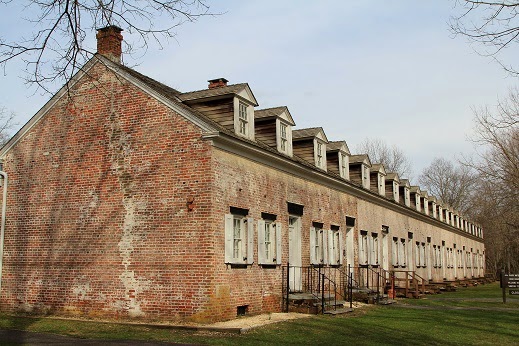
In Trenton we visited the Old Barracks, which was constructed in 1758 and is the only French and Indian War barracks still standing in the United States. The Barracks was also used by Washington after he defeated the Hessians in the First Battle of Trenton. Docents dressed in period clothing now give tours of the Old Barracks and explain what the living conditions were like for the soldiers during that time period. (You definitely wanted to be an officer!)


InfoAge is a National Historic Landmark located at Historic Camp Evans in Wall Township, New Jersey. Their slogan, “History Was Made Here,” caught my attention; so I decided to make a side trip to Infoage. Unfortunately, most of the exhibits are only open on weekends; but since the door to the main building was unlocked, we decided to give ourselves a self-guided tour of the rooms that were opened. Apparently, during WWII this facility was used as a Marconi Station and radar research laboratory. They also feature other types of WWII communications, military electronics, radio technology, electronic welfare; and they even have a fully stocked fallout shelter, so you know where to go in case of war. 


In the same general area is the Allaire Village, a 19th century industrial community that produced pig and cast iron. You can walk around the Village to view all of the old structures and if you are visiting during the summer months they have people dressed in period clothing demonstrating cooking, carpentry, blacksmithing, etc.


Tuckerton Seaport in Tuckerton is advertised as a “working maritime village,” featuring 17 historic and recreated buildings. However, almost everything was closed the day we visited the facility. Apparently, they try to appeal to families, so maybe there is more activity on weekends and during the summer months.

Apparently , a lot of schools do field trips to the facility because this is also the educational training center for the 115,000 acre Jacques Cousteau National Estuarine Research Reserve. The Reserve was established in this area to protect estuaries along the coast and the free educational center is open to the public.


We arrived at Historic Batsto Village only to find everything closed due to a forest fire in the area, and the fire fighters were using Historic Batsto Village parking lot as the command post! There were about 5 or 6 white news trucks, numerous other emergency vehicles, and lots of news people running all over the place, so they did not even notice when I parked my white SUV at the far end of the parking lot and started walking around taking pictures. One of the Park Rangers even walked up to me at one point and asked if he could help me; but when I told him that I was taking pictures for a story, he walked away. He didn’t ask what type of story that I was writing, so I guess he thought I was a news reporter.


The last stop of the day was the Towne of Historic Smithville & Village Greene, which is primarily a tourist facility for shopping and entertainment. It was raining and getting late in the evening, so we didn’t stay too long.


Friday, May 2, 2014

RonnieAdventure #0098 - Philadelphia, Philadelphia County, Pennsylvania.

Since Philadelphia is just across the river from the New Jersey Battleship, we decided to spend a day in the "City of Brotherly Love," also known as the "Cradle of Liberty." Philadelphia is home to Independence Hall and the location of where the Declaration of Independence and the United States Constitution were both signed and adopted. It also served as the meeting place for the United States Congress for several years and the place where George Washington served as president from 1790 to 1797.

On the lighter side, Philadelphia is the birthplace of the Philly Cheesesteak sandwich, one of the most haunted cities in the United States with one of the highest densities of haunted houses, Grace Kelly's birthplace (both her Farther and Grandfather won Olympic metals), and the place where the game of Monopoly originated. Apparently, while babysitting his children one night while his wife was away, a guy got the idea for the Monopoly game, but he did not have a large sheet of paper, so drew the game on his wife's white linen table cloth. They tell us that she forgave him after he made his first million. Did you know that Philadelphia is where the first fully electronic computer in the world was designed and built and at the time it was more than a thousand times faster than any other computing device?

We started the day out by taking a two hour bus tour around the City to get an overview of where everything was located; and, since it was a beautiful spring day, I sat on the upper deck so that I could take pictures. We had a very knowledgeable tour guide and, in addition to learning a lot of interesting facts about the City, we were entertained for the entire trip. The bus went around all of the historic downtown area first and then expanded the tour to include the US Mint, China Town, City Hall, Love Park, Logan Square, the Museum of Art (If you got off of the bus, you could run up the steps and have your picture taken with Rocky.), the Eastern State Penitentiary (This looked interesting, but we ran out of time to take the tour.), the Please Touch Museum & Memorial Hall (They ran out of money to operate the museum, so they sold the horse statues in front of the building. Unfortunately, the buyers had to sign a form that they would never move the statues from their current locations.), the Philadelphia Zoo, and numerous other places.


After the bus trip, we visited Independence Hall and the Liberty Bell, where we found out that "Pennsylvania" is not misspelled on the Bell. When the bell was forged, the State did not have an official spelling and "Pensylvania" was considered to be acceptable.


A short walk down the street from the Liberty Bell brought us to Christ Church, where George Washington, Betsy Ross, Benjamin Franklin, and many others attended services. The Church was founded in 1695 and was the first parish of the Church of England in Pennsylvania. It is also the birthplace of the American Episcopal Church. The burial ground is the final resting place for Benjamin Franklin and four other signers of the Declaration of Independence.


About another block down the street is the Betsy Ross house where the first American Flag was designed and sewn by Betsy Ross in her small upholstery shop.


The large bust of Benjamin Franklin is also located in this same general area. The last time I visited Philadelphia the bust was covered in bright, shinny pennies; but apparently tourist borrowed too many pennies for souvenirs, so now the bust is just painted with penny impressions.