Thursday, March 16, 2017

RonnieAdventure #0247 - Liberty Bell Arch, Mohave County , Arizona

File Picture
Back in the "good old days" if you wanted to hike to Liberty Bell Arch, you had to park your vehicle along the east side of US Highway 93 and then take your life in your hands while trying to cross the highway westward to reach the trailhead while crazy drivers from Arizona tried to run over you on their way to Las Vegas to loose their money.

Now that US Highway 93 is being developed into Interstate 11 between Las Vegas and Phoenix, the four main hiking trails south of Hoover Dam are being realigned to have a common trailhead ("White Rock Canyon Trailhead") that start from a large asphalt paved parking lot on the east side of the highway. The nice thing is that for the three trails leading to the west you no longer have to risk your life crossing the highway because you can now walk under two new bridges that cross White Rock Wash.


Since it was a beautiful spring day for a hike, we decided to take an alternate route to Liberty Bell Arch by deviating from the new trail after we crossed under the bridges and followed an old little used trail that went north and connected into the "good old days" original Liberty Bell Arch trail. Unfortunately, the side trip added about a mile to our trip, and it was all uphill to the old trail; but when you are retired you do not have to hurry. Besides, when you are with good company you can stop and visit along the way and reminisce about the "good old days." After reaching the top of the hill, we followed the old trail along the ridgeline and then went back down the hill to join the current Liberty Bell Arch Trail. Because of the rugged terrain in this area, it really reminds me of hiking in the Arizona Superstition Wilderness Area.


File Picture
File Picture

At the junction of the old and new trails, there is an old hand-made road that leads up the hill to a World War II Manganese Mine. You have to be careful walking around the hill because there are numerous vertical shafts that are not fenced leading downward to an adit (horizontal mine shaft) that exits into a wash on the north side of the hill. Although the vertical shafts provide light in the adit, no mine shaft should ever be entered as they may be unstable and can cave in at any time. There are a lot of old buckets, cables, mining equipment and "junk" scattered about the area, but everything at the mine is protected by law and cannot legally be removed from the site. 


From the old mine the trail goes down the hill, through a nice valley and then up another hill to the arch. The best views of the arch are from the south side after the trail passes in front of the rock formation. 


After passing in front of the arch, the trail continues up another hill to a nice overlook of the Colorado River gorge. We did not hike up to the overlook on this trip, but on a previous hike I did make the journey and really enjoyed the view of the Colorado River that is located about 1,000 feet below the rim. 


On the way back to our vehicle we skipped the extra loop on the "good old trail" and followed a trail that connected to the Hot Spring Canyon Trail, which resulted in a shorter hike back to our vehicle. 


Friday, March 10, 2017

RonnieAdventure #0246 - Valley of Fire, Dublin Wash, Shoshone, China Ranch Revisited

When we have out-of-state guests visiting, some RonnieAdventures are worth a revisit.

We started out by driving by the old St. Thomas town site that has resurfaced as the Lake Mead waters have receded. I have not visited the area in several years and was not aware that you are now required to walk a 2.5 mile trail from the mesa down to the old town site. Since we had to be back in Las Vegas in time to eat and see a Cirque dd Soleil show, we decided to save the hike for another visit.


There are so many things to see and do while visiting Valley of  Fire that we had to limit our visit to the south end of the Park. (See RonnieAdventure #0075, November 22, 2013 for additional information on Valley of Fire State Park.)

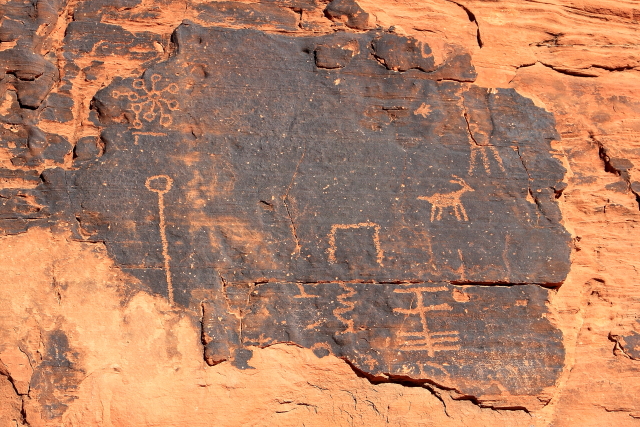
We started our visit by hiking through Petroglyph Canyon to Mouse's Tank. I have made this hike many times and each time I make the hike I find new petroglyphs that I have not noticed on previous visits.


At the end of Fire Canyon Road there is a precipice that is a popular photo stop. While we were there a tourist asked me to take his picture while he was standing on the ragged edge of nothing, so I agreed to do so. However, as I was focusing the camera, I asked the tourist to back up a few steps and then he just disappeared. I don't know where he went so quickly.


There are petrified logs on both sides of the park; and since I typically visit the logs on the west side, for a change we hiked up to logs on the east side.


Begin Natural Arch and a monument in memory of Sergeant John J. Clark are also located in this area. (I used the telephoto lens on my camera and photographed both the arch and the monument from the road.) 

Sergeant Clark was a Civil War hero and discharged from the military on March 6, 1963 after being wounded and then contracting typhoid fever. After his discharge he emigrated to Southern California and later while traveling to Salt Lake City (Utah) he died of thirst at this spot while presumably looking for water.


Shoshone (California) contains many historic buildings and is a nice place to stop for lunch.  

The Flower Building at the south end of town was constructed in 1939 by the Tecopa-Shoshone Women's Improvement Club. I don't know what a "Women's Improvement Club" is, but I guess that is where you send women that need improvement. (I'd better stop there before I get into trouble!)


The adobe building next-door was constructed by the T&T Bridge Gang after the town's restaurant that had been on the site burned down. In the 1930s The Famous Crowbar Cafe and Saloon was constructed on a site to the north and the adobe building was converted into the Inyo County Sheriff's Office. It is still in use as the Sheriff's Office. 


The Famous Crowbar Cafe and Saloon is well known for its "hand crafted cuisine in a traditional Western atmosphere" and also contains Jill "Lady Buffalo" Thacker's  "exquisite iron art work." This is a popular place not only because of its food and beverages, but also because they have wireless internet service that is provided by the Amargosa Conservancy and the Death Valley Chamber of Commerce. 


Probably the most photographed building in town is the Shoshone Museum that was built in Greenwater (California) in 1906 as a miners' union hall, then moved to the town of Zabriskie (California), and then to Shoshone in 1920 where it became a gas station and general store. In 1982 what was thought to be a Columbian Mammoth skeleton was discovered behind the gas station, and the bones were excavated by a group of college students. However, more recent studies have revealed that the bones are probably the remains of seven to nine different individuals, from two different genera and possibly three species, none of which are Columbian Mammoths. The bones are on display in the museum, along with a lot of  local history items, and other historical pieces are scattered around the outside of the building.  


The Shoshone Cemetery is located at the entrance to Dublin Gulch diagonally across the street from the museum. It is believed that there are at least 55 people buried here, many in unmarked graves or in graves that have almost vanished. On this trip I found a small child's grave that I had never noticed before.


Continuing up Dublin Gulch are the remains of several underground dwellings that were carved into the caliche clay embankment by miners in the 1920s. (For more information on Dublin Gulch, see RonnieAdventure #0035, January 5, 2013.)


China Ranch is not too distant and a nice place to spend the afternoon hiking and drinking date shakes. After about an hour's hike up to a different canyon that I had never visited before, it was time to head for home! (For more information on China Ranch, see RonnieAdventure #0036, January 10, 2013.) 


Friday, March 3, 2017

RonnieAdventure #0245 - Snowshoeing Mount Charleston Wilderness Area, Clark County, Nevada


There are a number of places that I have wanted to visit in the Spring Mountains during the winter, but the problem has always been the deep snow that covers the trails. So, when REI had their winter clearance sale and snowshoes were 51% off of the retail price, they made me an offer that I couldn't refuse. Of course, they should have given me a commission because I also talked several other people into purchasing snowshoes!

We had decided to make a trial run to test our new equipment, but when I picked everyone up on Saturday morning I realized that I forgotten to tell Kolohe that we were going to do part of the Mount Charleston North Trail Loop, which is fairly strenuous. The trailhead starts at 8,500 feet and goes over a 10,000 foot pass on the way to RainTree (an old Bristlecone Pine Tree). 

Since none of had ever been on snowshoes before, we started by following a trail that other snowshoers had made leading into the Mount Charleston Wilderness Area. This had its advantages and its disadvantages. It is nice to follow a trail with packed snow because you do not have to lift the tip of the snowshoe very high with each step; but, the disadvantage was the uneven snow packing and the trail was quite narrow in some places.    


Once we were higher on the mountain, there were less human tracks and more animal tracks, which was interesting. It also gave us the opportunity to try walking in fresh, unbroken snow. Fortunately, I had the camera, so only those on the trip will ever know if any of the snowshoers did not lift the toe of their snowshoe high enough while walking and fell forward into the powdery snow. 


We eventually reached a high enough elevation to see the Bristlecone Pine Trees, but we didn't make it over the pass to RainTree. (We found that snowshoeing takes a lot more time and energy than hiking on a dry trail.)


Going downhill turned out to be more exciting than going uphill because the spikes on the bottom of the snowshoes are slanted backward (i.e., toward the back of the snowshoe), so it requires a slightly different walking position. Anyway, the next day I realized that I had used some muscles in my hips and ankles that are not typically exercised when I go hiking. 

On the way down the mountain we knew that it had been a great day because Mother Nature provided us with a spectacular view over the Spring Mountains and a beautiful rainbow.