Friday, September 8, 2017

Ronnie_Adventure #0272 - The Total Solar Eclipse (August 21, 2017)

Picture by Jack Sneddon
After we arrived home, our insurance company informed us that the person who ran into us in Idaho did not have a valid insurance policy - Great!

We started processing the accident under our collision policy, then our insurance company called back and said that they made a mistake and the person that hit us did have insurance; so we needed to work with his insurance company to get our vehicle repaired. First step, get a fee quote for the repairs.

The local collision repair facility sent a repair cost to the insurance company and informed us that it would take about two weeks to repair our vehicle. I reminded the collision repair facility that the vehicle had to be repaired no later than mid-August because we planned to be in Wyoming to see the total solar eclipse. They assured us that they could easily meet that date. First mistake - We told them we did not need a rental vehicle because we were planning to be in town for the next two weeks.

About a week later I called our collision representative to see how repairs were progressing. No answer, so I left a message to call back. Over the next week I called our representative about five times and left messages to call back, but no return calls.

I finally called the insurance company directly and they informed me that they had not authorized the repair costs because were considering totaling the vehicle. They said that they would get back to me! I explained that 10 days before the accident I had purchased four new 70,000 mile Michelin truck tires (18-inch truck tires are not cheap), tuned up the engine (including new spark plugs, also not cheap), installed new exhaust manifolds and two new catalytic converters (nothing is cheap), new rear axle seals, bearings, and parking brakes shoes, for a total of $6,000; and I expected to be reimbursed for the repair costs if they totaled the vehicle. That did not go over real well!

After a number of discussions, the insurance company decided that they would fix our vehicle. Again, I reminded them that I need the vehicle repaired in time to travel north to see the total eclipse. I was assured that this would be no problem.

After numerous calls over the next few weeks with no returns, I finally drove down to the collision center and said that I wanted to speak to the manager. Surprisingly, the manager agreed that I had not received very good service and they informed me that my service rep was no longer with the company. Unfortunately, they also informed me that the damage to my vehicle was more severe than they realized and due to a bent frame that needed to be straightened I would not receive my vehicle in time to see the total eclipse. I asked for a replacement vehicle and they informed me that they could give me a replacement pickup, but it would not have an extended cab or box cover. I explained that I couldn't carry my suitcases in an open pickup box, so we finally negotiated for a SUV that they obtained from a local car rental company.

After two long days of hard driving, we arrived at my cousin's house in Boise, Idaho, which was only 60 miles from the total eclipse line. (Since our trailer was still in northern Idaho near the Canadian border, my gracious cousin invited us to stay at her house.)

The morning of the eclipse, we drove up to Weiser, with very light traffic on the road, and found a nice parking space by an elementary school with a large playground. After a few games of cards, it was time for the eclipse!


After the total eclipse was over, we drove over to the main viewing area (where the bulk of the people were located) for lunch and to purchase a few T-shirts. We followed some back roads on the return trip to Boise and made it home in about two hours.


While we were staying with my cousin in Meridian (just west of Boise) we visited the unBound Technology Library and learned how to use Tinkercad Basis and do 3-D printing. The facility is heavily used by teenagers that make Star Wars and comic book figures, so they all thought it was amazing that some old grandparents would come down to the Technology Library and use the equipment.


The last time I was in Nampa, the Warhawk Air Museum was closed; so this time I checked the times before I drove over there.

The 40,000 square-foot museum has a variety of WWI, WW II, Korean, and Vietnam aircraft and a large collection of memorabilia. One could easily spend all day in this museum.


P-51D Mustang
Curtiss P-40N Warhawk
Curtiss P-40E Kittyhawk
North American F-86 Sabre
Mikoyan-Gurevich MIG-17
Mikoyan-Gurevich MIG-21
Lockheed F-104A Starfighter
The Old Idaho Penitentiary is an interesting place to visit, but I would not want to live there - especially when it was fully operational. There were four prisoners per cell, except for the solitary confinement section, which was a very small room with very little light. Apparently, some prisoners killed themselves or went crazy before they could get out! The hanging room was on the second floor and had a trap door that dropped the person into a small chamber on the first floor. 


Sam Bruner (#723) gained "Trusty" status and was allowed to work in the steam power plant outside of the penitentiary walls. On December 30, 1901, Sam Bruner and the fastest prison horse, Old Selam, turned up missing. Sam Bruner and Old Selam were never seen again.


In October 1903 Charles Smith (#942) ran away while working outside the penitentiary walls. His tracks led to the Boise River, where it was assumed that he had drowned. In 1940, Smith turned himself in to the police department in Coeur d'Alene to "ease his conscience."


Caddie Shoup's (#1146) lover promised to marry her, but then he moved in with another woman instead. Feeling betrayed, she killed her lover in the bathtub and then tried to make it look like a suicide. The jurors found her guilty, but they felt sorry for her, so she was only given a three year, one month, one day sentence for voluntary manslaughter. 


Also located at the penitentiary is the extensive J.C. Earl weapons exhibit. 


Adjacent to the Penitentiary is the Idaho Museum of Mining & Geology that contains a piece of the oldest known rock in the world. The rock has been age-dated at 3.962 billion years old and was discovered on an island in the Acasta River, Northwest Territories, Canada. 


The College of Western Idaho Horticulture Technology Greenhouse is also located adjacent to the penitentiary, but it was late in the day when we arrived and they were just closing; so I had to settle for a few pictures of their outdoor gardens. 


Friday, September 1, 2017

RonnieAdventure #0271 - The Trip Home - Coeur d'Alene to Las Vegas

After leaving the Kootenai Health Care Facility in Coeur d'Alene, we decided to start the drive home so that we could make it back to Las Vegas in two more long days!

As we drove through the small town of Worley (population 257) I couldn't help but notice the number of large grain elevators in town. This is obviously a farming area.


The "Trail of the Coeur d'Alenes" (Hn'ya pqu'nn Trailhead) starts at the Veterans of The Schitsu' Umsh Park, just north of Plummer. Also located in the park is a metal sculpture and a Medicine Tree that was planted as a tribute to the historic "Grandfather Tree," which was a located near Worley; but was taken down in 2007 to make way for a new highway.


In 1876 the Coeur d'Alene Tribe failed to find enough buffalo in the Cataldo area, so they moved south where the soil was better for farming and established a new Jesuit Mission. We did not find any mission ruins, but there was a historic marker by the side of the road (GPS coordinates 47 08.946 -116 54.655) indicated that this was the site of the relocated DeSmet Mission.


At the top of the hill overlooking the Lewiston/Clarkston area, there is a nice view area that contains three historic markers.

Marker #176 notes that in September 1812, Donald Mackenzie set up a fur trading post along the river for the John Jacob Astor Pacific Fur Company. He built a store and two houses out of driftwood, but then discovered that there were very few beaver in this area, so he abandoned the post in 1813.

Marker #167 explained that Lewiston was named the first Idaho Territory Capital on July 10, 1863, and the first two legislatures met here. In 1863, when Lewiston was the Capital, the Territory was a large area that included Idaho, Montana, and almost all of Wyoming. In 1864, Montana was established as a separate territory and most of Wyoming became part of Dakota Territory, so the Capital of Idaho was moved to Boise, where it is still located.

Marker #314 indicated Lewis Clark State College was established in Lewiston in 1893 as a two year normal school to train teachers. It is now a four-year state college.


Clarkston (Washington) is just across the river from Lewiston (Idaho), but it is considered to be part of the Lewiston Metropolitan Area.


Driving south from Clarkson there are beautiful views of the Wallowa Mountains.


Enterprise (Oregon) only has a population of 1,940, but it is the Wallowa County seat and a popular tourist destination. There are numerous artists, craftsmen, and musicians that reside in Enterprise and there are two bronze foundries that produce original works of art.


Joseph is a picturesque town just south of Enterprise and is also a tourist destination with a lot of arts and crafts shops. The town is named for Nez Perce Chief Joseph (1840-1904) and is know as "Oregon's Little Switzerland." In September they have "Alpenfest," which resembles Oktoberfest, but according to the Chamber of Commerce there is more yodeling and alphorn playing.


Chief Joseph is buried just south of town in a meadow surrounded by wildflowers.


Elgin is a small town that was established to support the farming and logging industries. The local leaders also wanted to attract a little culture to the area, so in 1912 they built an Opera House that is still in use today.


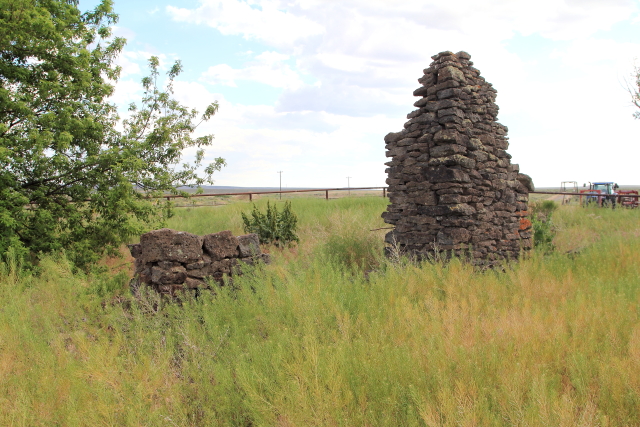
Jordan Valley is a small town near the Idaho border and has the distinction of having the only Basque handball court in the State of Oregon.

This area was primarily settled by Basques emigrants to herd sheep. The Basques emigrants brought their own language, religion, and sports with them and their favorite sport was pelota (handball). Jordan Valley's fronton (handball court) was constructed in 1915 by Basque masons who built the court from hand-hewn stones found just east of town. However, in the 1930s and 1940s, the younger generations of Basques lost interest in handball and started playing American sports.


Jean Baptiste "Pomp" Charbonneau (1805-1866) was the son of Sacajawea and Toussaint Charbonneau. "Pomp" was born at Fort Mandan and became the youngest member of the Lewis and Clark expedition. When Sacajawea died in 1812, William Clark became "Pomps" guardian and schooled him in St. Louis. At age 18 he "traveled to Europe where he spent six years becoming fluent in English, German, French, and Spanish. Returning to America in 1829, he ranged the far west for nearly four decades, as mountain man, guide, interpreter, magistrate, and forty-niner. In 1866 he left the California gold fields for a new strike in Montana. Contracted pneumonia enroute, reached "Inskip's Ranche," here, and died on May 16, 1866." He is burred near the remains of the old Inskip Ranch House on the plains of Oregon. (GPS coordinates 42 57 06.94 -117 20 21.17)


U.S. Route 50 is a major highway that runs east-west across the United States from Ocean City, Maryland to Sacramento, California. Author William Heatmoon stated that U.S. 50 was "for the unhurried, this little-known highway is the best national road across the middle of the United States" and on July 7, 1997, Time magazine devoted an entire issue to Highway 50 and called it the "Backbone of America." The Nevada portion of Highway 50 is known as "The Loneliness Road in America," due to the remoteness and lack of population in this part of Nevada. Driving this road should be on everyone's bucket list.


Austin (Nevada) is a small town (population 192) on Highway 50 that has a rich mining history with a population that has varied widely with the various mining strikes. 

Silver was discovered when a Pony Express rider's horse kicked over a rock and the rider noticed the silver. A town sprang up on the site and soon had a population of more than 10,000 people. After the silver played out, the population dropped until about 1910 when new ore deposits were discovered. Once again the population increased and then decreased until the 1950s when uranium was discovered in the area. The population increased and then after a few years decreased again. Austin is now considered to be a "living ghost town" and an example of an early Nevada mining town. The International Hotel is said to be the oldest hotel in Nevada. Stokes Castle, located just outside of town, is a three-story stone tower that was constructed in 1897 by a wealthy eastern capitalist who had a financial interest in several local mines. It was occupied for only a month and then abandoned.


The Hickison Petroglyph Recreation Area is located about 24 miles east of Austin on Highway 50 near Hickison Summit. There are self-guided tours along various trails near the picnic area


Eureka bills itself as "The Friendliest Town on The Loneliest Road in America." With a population of 610, Eureka is the county seat and by far the largest community in Eureka County. 

In 1864 a miner discovered rich ore in the area and shouted "Eureka!"; thus, the town's name. Soon the first important lead-silver deposits in the nation were developed and during the boom of the 1880s there were 16 smelters, over 100 saloons, an Opera House, a population of over 10,000 and a railroad that connected with the Transcontinental Line 90 miles to the north. Unfortunately, the boom was short lived and Eureka is now considered to be another "living ghost town" along Highway 50.


Now to get my truck fixed so that we can be back on the road again!