Following Historic Route 66 east from Daggett, the quality of the road deteriorates near Newberry Springs; but they keep patching the old "Mother Road" with more asphalt. Soon the surface is going to be more "patch" than "road." The trip is kind of like a drive down memory lane!
Along the way there are many old abandoned estates, gas stations, and motels that were once popular when people migrated west after WW II. Some of the old gas stations have even been converted to homes.
I remember when there were stands along the road were you could stop and purchase fresh fruit and product that was grown in the immediate area.
And, of course, every few miles there was a rock shop and quite often the rock shop building had a "bottle wall."
For the tourist from back east, throughout the southwest there were Indian jewelry stands that sold a variety of "Indian Jewelry." Of course, you always had to bargain about the price!
In 1883, the town of Bagdad was founded along the Atchison, Topeka and Santa Fe Railway between Daggett and Newberry Springs to provide services for the Orange Blossom and War Eagle mines. With the opening of the National Old Trails Road and Route 66, Bagdad remained a thriving community even after the mines closed. Then, in 1973, Interstate-40 was constructed and bypassed Bagdad; so, the businesses closed and people moved away. In 1991 the few remaining buildings in Bagdad were razed.
However, in 1987 Hollywood wanted to produce a movie in the area; so, they renamed the Sidewinder Cafe in Newberry Springs "Bagdad Cafe," which became the name of the movie. Then in 1990, CBS produced a television series called Bagdad Cafe that was based on the movie. The television series stared Whoopi Goldberg and Jean Stapleton. The "Bagdad Cafe" is still open and a popular stopping spot along Historic Route 66.
I was surprised when the Welcome Sign said that the population of Newberry Springs was 2815 because there were only a few buildings along the road. Then, I noticed on the sign in fine print that the town area contains 117 square miles! As the sign says, there is "Plenty of room for you!"
From Newberry Springs, the Historic Mojave River Road runs north up to Interstate-15.
In 1776, Fr. Francisco Garces was the first recorded European to follow this route on his way to reach the Southern California Missions. In 1826, Jedediah Smith was the first American to use the road to reach the California Coast via an overland trail. Kit Carson and John Fremont also followed the road on their westward journeys.
After various Indian raids, in 1860 the U.S. Army established Camp Cady along the Mojave Road about 9 miles east of "Forks of the Road," which was the junction of the Mormon Trail, (part of the Old Spanish Trail) and the Mojave Road. The adobe fort was 40 feet square and manned by 80 troopers from the 1st Dragoon Regiment.
In 1861 the regular troops left for the Civil War and the roads were patrolled by California Volunteers until 1865 when the 4th Cavalry regarrisoned the post. By this time, about 2,000 wagons were using the road each year. In 1871 the road was considered to be safe, so Camp Cady was abandoned.
When I followed the Historic Mojave River Road, the sand plows had been out so four-wheel-drive was not required. Above the north bank of the Mojave River I even located the Camp Cady monument.
When I reached Interstate-15, I found the abandoned Jeremy's facility; and a lot of "junk." Since the Mojave River runs underground at this location, it appears that Jeremy's Boat Rental business didn't do too well.
Following Interstate 15 toward Las Vegas, Dunn (CA) is located on the north side of the freeway. Based on a sign in front of the Market, this probably would not be a good campaign stop for Bernie Sanders! Just remember that "love" spelled backwards is part of the Ron Paul "revolution."
When traveling from Barstow to Las Vegas, it is possible to follow Historic Route 66 to Daggett, and then take a farm road about two miles north to Interstate-15 in Yermo. Sine a visit to Daggett had been on my Bucket List for a number of years, I decided this was the day for a visit. (If you remember the TV show Battlestar Galactica, "Daggett" was the name of the robot dog. The question is, did they take the dog's name from the town of Daggett?)
Historic Route 66 is the same as Main Street in Barstow and the road runs parallel to Intedrstate-40 all the way to Daggett; so when leaving Barstow I just stayed on Main and crossed over Interstate-15 that I typically take to Las Vegas.
I was about two miles out of town when I came to a blockade across the road with a Marine MP standing in a guard shack. When he asked me where I was going, I explained that I was following Historic Route 66 to Daggett. He quickly informed me that the military had taken control of this section of the road and it was now part of the Marine Corps Logistics Base, a restricted area. The MP was an extremely rude and obnoxious person and after a few questions, he demanded to see my driver's license. I informed him that I did not have to show him my driver's license because he was not going to allow me to enter the restricted area. He strongly disagreed with me and after some some additional discussion, I decided it was easier to show my driver's license then take a bullet in the head. However, after taking my driver's license, he refused to give it back to me until I turned around and was headed back toward Barstow. I finally got my driver's license back and returned to the nearest Interstate-40 freeway entrance. After about two miles I was able to exit the freeway at the Nebo exit and get back on Historic Route 66.

Daggett (population 200) was founded in the 1860s after silver was discovered in the area. When the Southern Pacific Railroad reached the area in 1882, the miners wanted to call the town Calico Junction; but the name was considered to be too confusing since the town of Calico was just a few miles away. It was finally agreed upon to call the town "Daggett," after California's Lieutenant Governor John Daggett.
For a number of years Daggett was the terminal for the Death Valley twenty-mule teams that carried Borax from the Death Valley mines to the railroad junction in Daggett. However, after one of the railroad's swampers was lynched in Daggett, the railroad moved the terminal to Mojave.
When Borax was discovered in the nearby Calico Hills, Daggett had a population boom as miners moved to the area to support the mines. Daggett once again became a rail junction when a new rail line was constructed for moving ore to the processing plant in Daggett. At its peak, Daggett was considered to be a "big city," with three stores, two restaurants, three saloons, three hotels, and a lumberyard.
By 1911 the mines started to played out and people moved away, causing Daggett to become a near ghost town until WW II.
During WW II the government built an airport near Daggett to be used for modifying Douglas A-20 Havoc Bombers that were sent to Russia as part of the Lend-Lease program. After the war, the government did not have any use for the base; so the facility was turned over to the community and the base now serves as a general aviation airport serving the Barstow-Daggett-Calico area.
Although it did not substantially increase the area population, the world's first commercial solar power plants, SEGS I (built in 1984) and SEGS II (built in 1985), were built just east of Daggett. At about the same time, Solar One was constructed in the same general area. Solar One was a pilot Solar Thermal Energy project that used mirror-like heliostats to aim sunlight at a sphere containing oil to produce steam for a power generator. In 1995 the facility was upgraded and renamed Solar Two. At that time, oil in the sphere was replaced with molten salt compounds as an energy transfer medium.
In 1999 the plant was decommissioned and in 2001 the facility was converted into a gamma-ray astronomy telescope site. The facility was known as CACTUS (Converted Atmospheric Cherenkov Telescope Using Solar-2) and was operated by the University of California. When National Science Foundation funding ran out, the facility was closed and demolished in 2009.
A map of historic buildings in Daggett is available and describes some of the more notable structures.
The stone hotel was built in 1875 and was originally two-stories with a second floor balcony and a large glass dome above the two-story lobby. After the last fire in 1905 the hotel was restored to a one-story structure. The walls are two feet thick and still in "excellent" condition. John Muir was a frequent guest at the hotel because his daughter Helen was married to Buel Funk and lived in Daggett. Helen Funk's house is now the Augustan Society headquarters. The People's General Store is adjacent to the hotel, but it is in very poor condition.
The Fout's Building was originally a roundhouse for the narrow gauge railroad that was used to haul ore from Calico to the processing plant in Daggett. After the railroad was abandoned, the building was used as a livery stable, then a gas-buggy garage, then a grocery store, and finally an automotive garage in the 1940s.
Alf's Blacksmith Shop was used to build wagons to the same specifications as the Death Valley-Mojave Wagons used to haul Borax.
The building with an usual roof design was originally a restaurant, but has now been converted to a single family house.
The original General Supply Store was destroyed by fire in 1908; so it was rebuilt using a rail carload of cement, making it the first fireproof structure anywhere in the Mojave Desert. Today the building is used for the Desert Market.
A history of the Daggett area is on display at the Museum, but the Museum is only open on Saturdays.
Throughout the town there are numerous historic building still in use and many that have been abandoned or burned down.
The old Daggett Pioneer Cemetery is located south of town and contains a number of graves with unknown occupants.
Going north out of Daggett the road crosses the Mojave River and then passes the old American Borax Works ruins. At this location, the Mojave River is known as the "Upside-Down River" because the water runs underground as it passes through Daggett.
Continuing north for about two miles, the road comes to Interstate 15 in Yermo, and Peggy Sue's 50s Dinner. Peggy Sue's is almost exactly half way between Las Vegas and Long Beach, so it is a nice place to stop for some refreshments. In addition to food /beverages and souvenirs, they even have their own Diner-Saur Park.
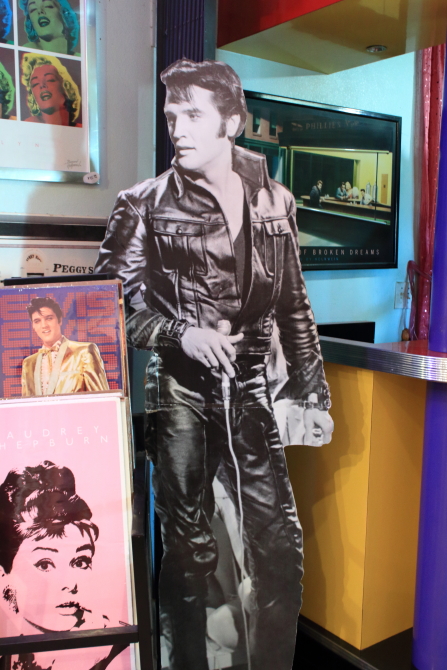
If you need an words of wisdom, the King is always available to answer questions about your concerns. James Dean and Betty Boob can also be found hanging around the building.