Friday, December 10, 2021

RonnieAdventure #0494 - Oklahoma 2021 Part II


There is a large cross that is hard to miss at the junction of I-35 and 2nd Street in Edmond, Oklahoma. The cross was built in 1998 on the MetroChurch Campus, stands 138.5 feet tall, and is made of 8-inch-thick prestressed-high-strength-concrete. MetroChuch is now part of LifeChurch.tv. 

Located just to the west of the cross is the University of Central Oklahoma Campus where there is a large statue of the Minneconjou Teton Lakota Indian Chief Touch The Clouds. Touch The Clouds was the youngest son of Lone Horn and his brothers were Spotted Elk, Frog, and Hook Nose. He may also have been a cousin to Crazy Horse. 

Touch the Clouds was known for his bravery, physical strength, skill in battle, and diplomacy in counsel. After the Battle of the Little Bighorn, Touch the Clouds took his tribe north to escape the cavalry, but eventually he surrendered at the Spotted Tail Agency in Nebraska. After his surrender, for the rest of his life he worked to get his people an education. 


Guthrie (population 10,191) was the First Capital of Oklahoma Territory and Oklahoma when it became a State. Some of the original buildings located in the historic section of Guthrie are now being renovated and repurposed. 

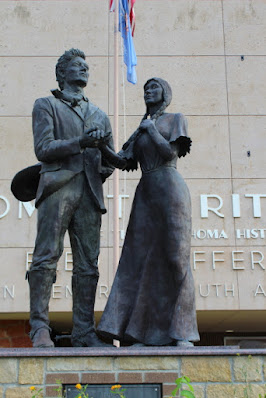
In 1889 the Guthrie National Bank was the first brick building constructed in Oklahoma Territory. It was also the first chartered national bank in the Territory. The first drugstore is now the Oklahoma Frontier Drugstore Museum and Apothecary Garden. Located just down the street is the Carnegie Library, which is now part of the adjacent Oklahoma Territorial Museum. In front of the museum is the Oklahoma Statehood Wedding Statue. The Statue symbolized "Miss Indian Territory" coming together with "Mr. Cowboy Oklahoma Territory" on November 16, 1907, to form the State of Oklahoma (46th State). 


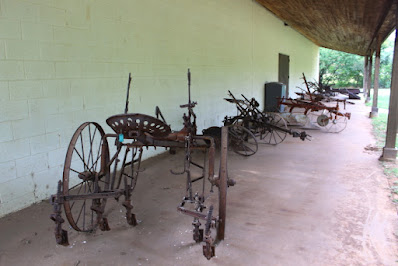
There are several museums around Oklahoma that feature the Cherokee Strip Land Run of 1893, and one of the museums is located just outside of Perry (population 5,128) The Perry museum is located on five acres of land and contains several buildings and outdoor exhibits that are all part of the museum complex. 

At noon on September 16, 1893, the largest of the Oklahoma Land Runs started with 100,000 homesteaders racing to claim 42,000 homesteads. Immigrants from almost every place in the Unites States and many people from foreign countries participated in the land run. 


Located just outside of Tonkawa is the Wilkins Oklahoma Truck Supply Company and a good example of what can happen when an inexperienced truck driver forgets the Golden Rule - "Always apply the trailer brakes first." Applying the truck's front brakes first can result in a disastrous situation. 


Ponca City (population 25,387) is home of the Conoco Oil Museum that contains a history of the oil industry from wildcat days to current oil production technology. Oil enthusiast could spend a lot of time in this museum watching movies and playing with the hands-on equipment.  


In the early 1900s E.W. Marland made a fortune in the oil business when he was living in Pennsylvania. but he lost everything in the Panic of 1907. Marland decided to move west and when he and his wife arrived in Ponca City, Oklahoma, in 1908, they owned nothing more than a few clothes. 

Once again Marland entered the oil business and started his own company. Within a few years he had amassed a fortune of $100 million and controlled ten percent of the world's oil reserves. After his oil career, Marland went on to become Governor of Oklahoma. 

In 1928 Marland constructed the E.F. Marland Mansion at a cost of $5.5 million. The Mansion is modeled after the Davanzati Palace in Florence, Italy, and contains 43,561 square-feet of living space in 55 rooms. Within the Mansion are twelve bathrooms, seven fireplaces, three kitchens, an elevator, Waterford crystal chandeliers, and a ballroom with a 24-karat gold leaf-covered ceiling that is now worth over $1.9 million. The Mansion is known as the "Palace on the Prairie" and guided tours are available on a scheduled basis.  
  

Also located in Ponca City is the Pioneer Woman Museum & Statue that is dedicated to the pioneering women and their influence and contribution to development of the State and Nation. The 17-ft. tall bronze statue is called "Confident." 

In 1926 twelve sculptors were asked to create a pioneer woman statue and upon completion, the twelve statues were toured around the country by train. At each train stop people were asked to vote on their favorite statue. Thousands of people voted on the statues and "Confident" was selected as the winner. In 1930 the statue was dedicated with over 40,000 people in attendance. Will Rogers was the Master of Ceremony at the dedication.  


The 1893 Land Run Historical Center in Medford (population 996) is another one of the museums in Oklahoma dedicated to the events of 1893.

Through various treaties in the mid-1800s, the US Government gave the Cherokee Indians substantial lands in northwest Oklahoma that became known as Cherokee Territory. 

During the Civil War, the Cherokee Indians decided to fight for the Confederacy; so after the War the government reduced the size of the Indian Territory as punishment for supporting the Confederacy. The Indians were  paid $8.5 million for 6 million acres of land that the US Government reclaimed. 

On September 16, 1893, the reclaimed Indian lands were opened to settlers in the largest land rush in Oklahoma history. The land run started at noon and an estimated 100,000 settlers filed claims for the 42,000 land parcels. On that day the cities of Enid, Perry, Alva, and Woodward were established on homesteaded lands.   


The Great Salt Plains just west of Medford are similar to the area around the Great Salt Lake in Utah. While the Great Salt Lake in Utah is too salty to support fish, the Great Salt Plains Lake in Oklahoma is not as salty and the water supports fish and other wildlife. Water tests indicate that the saline content is about one-fourth that of the ocean. The Great Salt Plains National Wildlife Refuge surrounding thee Lake contains over 50-square miles and is under joint management between the US Fish & Wildlife Service and the Oklahoma Great Salt Plains State Park. 

Selenite crystals are found just below the salt encrusted surface around the lake, but digging for crystals is only allowed in a designated area. During WW II the Army Air Corps used the area as a gunnery range and later Chemical Agent Identification Sets (CAIS) were dumped on the site. The military has cleared an area of munitions and CAISs that is now open to the public, but the public is not allowed outside of the delineated area. Unfortunately, I found myself on the wrong side of the lake and did not have time to drive to the other side of the Lake to hunt for selenite crystals. 


After leaving the Lake, I encountered a really large golf ball and some unique roadside art.

GPS Coordinates: 36.740580 -98.127780
GPS Coordinates: 36.797392 -98.575447


Friday, December 3, 2021

RonnieAdventure #0493 - Oklahoma 2021 Part I


It has been several years years since I visited Oklahoma, so I decided it was time for another Oklahoma RonnieAdventure. I flew to Oklahoma City, rented a car, then tried to drive mostly on backroads and visit small towns, attractions, and interesting areas along the way. 

After leaving the airport my first stop was in Okarche (population 1,445), home of Eischen's, the oldest bar/restaurant in Oklahoma. Tourist literature said that Eischen's served the best fried chicken in the area; but the restaurant was not open, so I had to settle for a picture of the place. 

Up the road a spell in Kingfisher (population 4,875) there is a small park on the Walmart property that contains a statue of Sam Walton and his dog Ol' Roy. This is probably the only Walmart store in the world that has its own park on the property and a statue of Walton and his dog. 

Walton was born in Kingfisher and worked with his father on the family farm until the Great Depression. When farming did not produce enough money to support the family, his father went to work for an agent of Metropolitan Life Insurance Company foreclosing on farms. The family later moved to various town in Missouri where Sam became the youngest Eagle Scout in the state's history. In later years he was awarded the Distinguished Eagle Scout Award for his community service.

While attending school, Sam had a paper route, sold magazine subscriptions, milked cows, bottled the surplus milk and delivered milk to customers. When he graduated from high school he was voted "Most Versatile Boy."

After working his way through college by doing odd job and waiting on tables in exchange for meals, Sam was hired by J.C. Penney in Des Moines, Iowa, as a management trainee for $75/month. However, his management career was cut short by WW II. After joining the military he was assigned to Fort Douglas near Salt Lake City, where supervised security at aircraft plants and prisoner of war camps. While in the military he reached the rank of Captain. 

After the War, at age 26, Sam purchased the Ben Franklin variety store in Newport, Arkansas, and the rest is history. 


Also located in Kingfisher is the Jesse Chisholm, Ambassador of the Plains Museum.

Jesse Chisholm was a Cherokee fur trader that is known for having scouted and developed what is now known as the Chisholm Trail. Before the railroads reached Texas, the Chisholm Trail was used to drive large herds of cattle from Texas to the railheads in Kansas. 

Chisholm was fluent in thirteen Native American languages and served as an interpreter between the various Indian tribes and the Republic of Texas and later with the United States Government. Because he negotiated numerous treaties between the Indian tribes and the governments, he became known as "Ambassador of the Plains." Although Chisholm lived in Kingfisher, he died of food poisoning at a camp near Left Hand Spring (near Geary, Oklahoma) and was buried there. 


I had not planned to stop in Hennessey (population 2,925), but when I passed an old abandoned Sinclair gas station my car automatically pulled over so I could take a few pictures. The car also pulled over at "The largest Quilt Shop in Oklahoma." Fortunately, the quilt store was closed. 


I remember when I was growing up our family went to Enid (2019 population 50,394) to visit my cousins. One of my Father's older sisters and her family lived there. Since my Oklahoma cousin now lives in Boise, Idaho, I am including a picture of Enid High School for her. 


The Midgley Museum in Enid was not open, but I understand that they have a large mineral collection. The museum building itself is unique in that it was built using rocks and minerals that the Midgleys collected over the years on their rock hunting trips. 


The town of Ames (population 262) is located in the center of the Ames Astrobleme, which was caused about 450 million years ago when a meteor estimated to about 300 feet in diameter crashed into the earth traveling at a speed of 100,000 miles/hour. Although the crater is now filled with dirt and not visible from the surface, it is the most thoroughly studied impact crater on Earth.  A museum is located in the city park and contains a video and other descriptive information about the astrobleme.


When I passed through Seiling (population 875), I could not help but notice the number of murals painted on sides of building in the downtown area. I have only included a few of the mural pictures. 

The town is named for Louis Seiling, who acquired a homestead in the lands during the Cheyenne-Arapaho Land Run of 1892. Seiling is now the largest city in Dewey County. 


Watonga (population 2,881) was named for Arapaho Chief Watonga, whose name means "Black Coyote." The town is located on lands that were part of the non-Indian settlement in the April 19, 1892 Oklahoma Land Run. 

Three notable people are from Watonga - T.B. Ferguson, Clarence Nash, and Tom Love

Thompson Benton Ferguson was editor of the Reublican newspaper in Watonga when President Theodore Roosevelt sent Ferguson a telegram offering him the position of Governor of Oklahoma Territory. Ferguson's wife received the telegram and quickly responded back that he would accept the appointment without ever consulting with her husband. Apparently her acceptance for her husband did not cause a divorce in the family.

Clarence Charles "Ducky" Nash, the original voice of the Disney cartoon character Donald Duck, was born and raised in Watonga. In the 1920s Nash moved to California and was a voice impressionist for a Los Angeles radio station. He was then hired by the Adohr Milk Company for publicity purposes and called "Whistling Clarence, the Adohr Bird Man."  His job was to roam the streets and give out free treats to children. 

One day Nash happened to be going by the Disney studio and stopped to give the receptionist a copy of his Adohr publicity sheet. He was recognized by the receptionist from his radio work and she asked him to make an informal audition for one of their casting directors. After his audition, the casting director called Walt Disney and Nash was hired immediately. Nash went on to be the voice of Mickey Mouse for 51 years. 

In 1964 Tom Love spent $5,000 to lease an abandoned service station in Watonga. Over the next eight years he expanded the chain with 40 additional stations. Then, in the 1970s a "Mini Stop Country Store" was added to the Watonga station. (It is believed that this was the first mini-market in the United States located in a gas station.) The concept was so successful that mini-mart stores were quickly added to other gas stations in Love's chain. Next, a deli was added to the stores and in 1993 Taco Bell restaurants were added, followed by a host of other fast food brands. Love's now has 500 gas stations located throughout 41 states and over 25,000 employees.

The Blaine County Courthouse and the T.B. Ferguson House are both listed on the National Register of Historic Places. The T.B. Ferguson Victorian-style House has been converted into a museum and is currently undergoing a renovation.