On the north shore of Lake Superior, not far from Tofte, Minnesota, is a cross that was erected in honor of Father Frederic Baraga. Because the fog and haze was so thick the morning I visited the site, I had to wait for about 30 minutes for the sun to rise high enough to take pictures.
Father Baraga came to the United States from Slovenia in 1830 to minister to the Native Americans in the Upper Great Lakes area. In 1846, there was an epidemic afflicting the Native Americans at Grand Portage, so Father Baraga left from Madeline Island with a Native guide in a small boat to take supplies and minister to the sick. On the way to Grand Portage, they were caught in a bad storm with no way to reach shore. However, it was described as a miracle when a large wave picked up the boat and carried it over a sandbar to safety in the mouth of the Cross River.
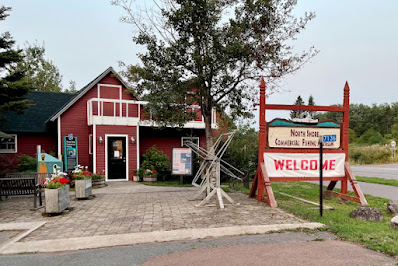
Located in Tofte (population 269) is the North Shore Commercial Fishing Museum that is dedicated to the Scandinavian immigrants who played an important role in the development of commercial fishing in northern Minnesota. The museum is a replica of the fish house built by the town's founders Andrew and John Tofte and Hans Engelsen.
Most fishermen were from Norway and typically worked alone or in small groups. In its heyday, there were fishing establishments about every half-mile along the north Superior shoreline. Whitefish, herring, trout, and pike caught by the fishermen were packed and shipped throughout the United States.
A large wooden reel was on display in front of the museum and a sign explained its use. Nets used by the fishermen were made from heavy cotton and could not be left wet or they would rot. Therefore, at the end of the day, the nets were wound around large revolving wooden reels to dry. While the nets were being wound around the reels, they were also easy to repair.


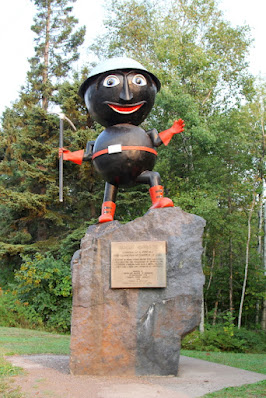
In 1959, a young dentist named Otto Ringle moved to Silver Bay (current population 1,857) and established a dental practice. He was aware that there were several towns in Minnesota that had erected large statues of Paul Bunyan and Babe the Blue Ox to attract tourists to their community, so when he was president of the Silver Bay Jaycees he suggested that a large statue be built in Silver Bay. However, since Silver Bay is the "Taconite Capital of the World," and Reserve Mining Company had a Taconite mine in Silver Bay, he suggested the city build a "Mr. Taconite," rather than a Paul Bunyan statue. Reserve Mining liked the idea and said that they would pay for the statue and donate a 7-foot block of taconite for a pedestal, but the statue had to be made from iron. The statue was built of iron and dedicated in 1964. A contest was held for a new statue name and the statue is now known as "Rocky Taconite."
Located on the outskirts of Two Harbors (population 3,633) is a 30-foot-tall Peter Toth statue that was carved in July 1977. A sign states: "This sculpture is a creation of artist Peter Toth and is his gift to the people of Minnesota. It is one of fifty such monuments which he plans to erect. One in each state of the union. The artist is motivated by his great devotion to the American Indian and his hope that his work will draw attention to the problems confronting descendants of the 'original Americans.' Lake County and the City of Two Harbors are grateful and proud that the artist selected that site for his monument in Minnesota." This is one of the few Peter Toth statues that does not have a name.
There are three large ore docks that extend into the west side of Agate Bay for loading ships, and from the east peninsula there is a levee that extends into the bay to protect the ore docks. There is a light at the end of the levee marking its location.
The Two Harbors lighthouse at Agate Bay was built in 1891 and originally the light was equipped with a fourth order Fresnel lens. In 1969 the Fresnel lens was removed and replaced with a 24-inch DCB-224 Aerobeacon that could be seen for 17 nautical miles. Ownership of the lighthouse was transferred to the Lake County Historical Society in 2001 and the building is now used for a museum.
Located in a parking lot north of the lighthouse is a Voyageur statue that was carved by John Gage using a chainsaw.
I have visited some unusual museums, but the Sandpaper Museum in Two Harbors was definitely unique. Since the museum was not open, I could only look at the exhibits through the front window.
Located directly across the street from the Sandpaper Museum is Thomas Owns Memorial Park. The park is dedicated "To the memory of those men of vision and courage, who promoted the Duluth & Iron Range Railroad Company. They builded better than they knew."
There is a large iron ball in the park that commemorates the "first shipment of iron ore from the state of Minnesota, through the port of Two Harbors."
Also located in the park is a World War I German Cannon. During World War I US troops were stationed in Two Harbors to protect the railroads from sabotage. In 1929, a German made canon that had been on display by the Courthouse was being scrapped, so it was acquired by the American Legion and eventually ended up in the Park.
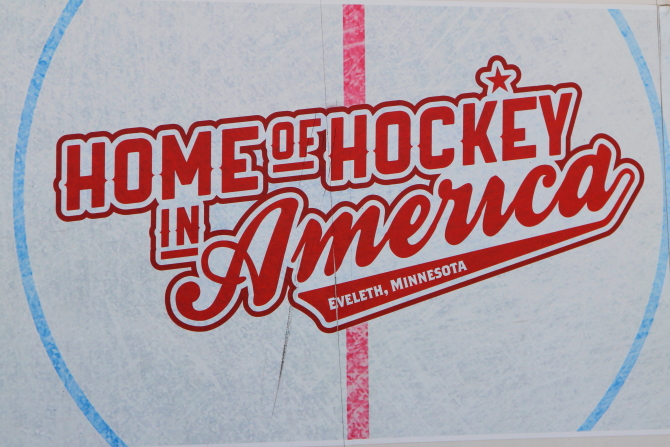
Eveleth (population 3,718) is called the "Home of Hockey in America," and home of the United States Hockey Hall of Fame. The city is noted for producing some of the greatest hockey players.
Located in a city park is the "World's Largest Hockey Stick," along with various statues and a wall of informational signs about hockey. The hockey stick is 107 feet long and weighs 3 tons.
A placard by one of the metal statues stated that Eveleth native John Mariucci was the "Godfather of Minnesota Hockey." He was a player, coach, and promotor for youth hockey programs and facilities. In 1956 he was part of the U.S. Olympic Hockey Team that played in Cortina d'Ampezzo, Italy.
A placard by a metal statue of Frank Brimsek ("Mr. Zero") stated that he was an Eveleth native that earned the nickname "Mr. Zero" because as a rookie he had six shutouts in his first eight NHL games. He was an original member of the U.S. Hockey Hall of Fame.
The Laurentian Divide is located in Superior National Forest a few miles north of Eveleth. This is the ridge line where water on the north side flows into the Artic Ocean and water on the south side flows into the Atlantic Ocean.
A placard stated: "The name 'Laurenitian' is used because the granites forming the ridge are similar to, and were once thought to be related to, granites of the Laurentide Mountains in Quebec. Although this connection is no longer made, the name has remained."
Another sign at this location explained continental divides as follows: "Continental divides aren't just in the Rocky Mountains - Minnesota actually has THREE continental divides! A continental divide is a boundary between watersheds which drain to different oceans or different sides of a continent. In Minnesota, one watershed drains to the Mississippi and out to the Gulf of Mexico, a second drains to Lake Superior and out to the Atlantic Ocean, and the third drains to Hudson's Bay and out to the Arctic Ocean. The Laurentian Divide at this marker is also called the Northern Divide and known locally as The Height of Land. It is the continental divide that separates the Hudson Bay watershed to the north from the other two."
International Falls (population 5,802) is located along the Rainy River directly across from Fort Frances, Ontario, Canada. The two cities are connected by a bridge and there are ports of entry on both sides of the bridge.
International Falls, or "I-Falls" as nicknamed by the locals, is known as the "Icebox of the Nation" because on the average there are 109.4 days per year with a high temperature below 32 degrees Fahrenheit. A record low temperature of -40 degrees Fahrenheit was recorded on 2008.
Driving into town visitors are greeted by a large Smoky Bear statue, which is the largest of its kind in the United States. The 26-foot tall statue was erected in 1953 by Koochiching County's Keep Minnesota Green Committee.
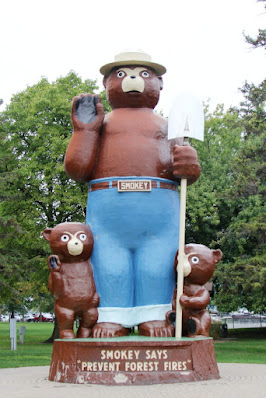
Just across the street from the Smoky Bear statue is the Bronko Nagurski Museum. Nagurski was a NFL Offensive and Defensive Tackle with the Chicago Bears, and then became a professional wrestler where he was a multiple-time World Heavyweight Champion.
While playing football, Nagurski was nicknamed "The Monster" because of his size. It was reported that once while carrying the ball he knocked two linebackers in opposite directions, stomped a defensive back, crushed a safety, bounced off the goalpost, and then cracked the brick wall at the end of the field when he ran into it. After returning to the huddle he reportedly said: "That last guy hit me awfully hard."
On another occasion the Bears were going to punt the ball and a Green Bay Packer player told Bear's Red Grange who was blocking him, "I promise not to try to block the kick, Red, but get out of the way so I can get a shot at that Polack." When the ball was snapped, Red Grange allowed the Green Bay Packer to charge into Nagurski as hard as he could. He bounced back, fell to the ground, and then said "Hey, Red, don't do me any more favors."

A trip to International Falls would not be complete without crossing the river into Fort Francis. Since I was driving a rental SUV that could not be taken out of the US, and there were no bikes available at the visitor center, I had to walk across the bridge.
Big Vic, Voyageur Statue, located in Ranier just east of International Falls, is 25-feet tall and weighs 2,300 pounds. Vic and his twin brother Louie were built in 1975 and used in protests against the Federal Government when the government was using eminent domain to acquiring private lands in the area. A sign by Vic states: "These two legendary Voyageurs continue to stand as symbols of protest and justice and as a reminder that no power is too great to confront,"