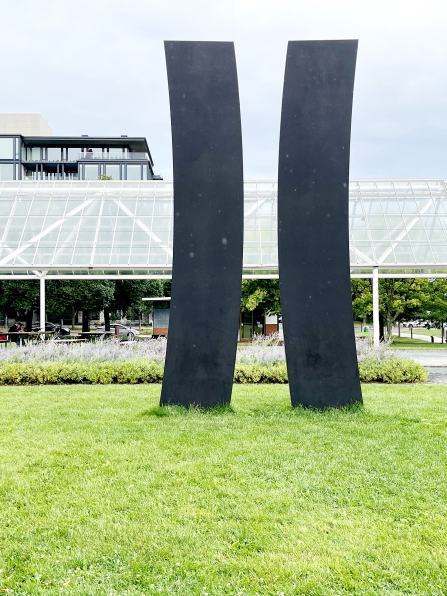
For a small town, Vining (population 62), Minnesota, has a major scrap-metal sculpture art exhibit that was created by Ken Nyberg. In 1989, Nyberg built his first giant sculpture, "Big Foot," without telling anyone about his project, including his wife. He was afraid people would think he was a big fool and a bit goofy.
When completed, "Big Foot" was 18-feet high and weighed over 1,200 pounds. To his surprise, people liked "Big Foot." Therefore, he started building other large sculptures, including a statue of himself working on scrap metal. He also built a statue of his daughter Karen, who was a NASA astronaut and the 50th woman in space. She spent 180 days in space in 2008, in 2013 she was a mission specialist on STS-124, and she was a flight engineer on Soyuz TMA-09M.
Wadena (population 4,325) is named after an Ojibwe Indian Chief. The city is located in an agricultural community and serves as a regional hub for the Tri-County area.
The Northern Pacific Railroad Passenger Depot was built in 1915, and is now used by the Wadena Area Chamber of Commerce. There is a nice gazebo in front of the building, various metal art project are scattered around the site, and a nice flower garden on the east side of the property.
Staples (population 2,989) has an active Amtrak train station that is located on the main route from Chicago to Seattle. More than 5,000 riders a year get on or off of the train in Staples. Located in the parking lot was a beautiful restored 1959 Cadillac that someone had driven to the train station.
The historic Queen Anne-style Almond A. White House in Motley (population 680) was built in 1902, and is unique compared to other building in town. The first floor contains a parlor, library, dining room, and kitchen. A summer kitchen is located at the rear of the house. Bedrooms are on the second and third floors with windows in the end gables. A tower and several dormers are on the north slope of the roof. There is a sunroom on the fourth floor and there is a tall lighting rod that rises over ten feet above the tower's roof. The White House is a showplace in Motley and the locals call it "Motley Castle."
Located in a downtown park, the Motley Historical Society has erected a tower for a bell that was rescued from the original one-room schoolhouse and also in the park is a monument with part of Motley' history. The monument explains that the town received its name when a Northern Pacific Railroad official looked at the rough-hewn workers gathered at the railhead and exclaimed "What a motley crew."
Baxter (population 8,612) is located in a geographical moraine area that was created in the Ice Age by the Superior Lobe of the Labradorian ice sheet. Located along the highway are various painted oxen. I could not find any information about what the oxen represent, but one ox in front of a bank was named "Elvis Babe Ox."
Brainerd (population 14,395) is located just across the Mississippi River from Baxter and is the location where Paul Bunyan left his flashlight.
Crosby (population 2,360) was built for the sole purpose of mining. Consequently, it is the location of Minnesota's worst mining accident. On February 5, 1924, a new mining tunnel was being drilled too close to Foley Lake. When the tunnel collapsed, water rushed in, killing 41 miners.
In 1957, an Air Force major launched a high-altitude balloon from a 400-foot-deep mine crater near Cosby and the balloon climbed to nearly 102,000 feet above the earth as part of Project Manhigh. It was reported that this flight helped the United States make a large step into space exploration.
Located on the shore of Serpent Lake is a serpent that makes his home in a park on dry land.
Deeerwood (population 526) received its name from the abundant deer population in the nearby woods. Residents decorate the town's icon several times a year with different costumes. During deer season he wears a blaze orange coat and at Christmas he becomes Rudolph with a big red lighted nose.
In the early 20th century, Aitkin (population 2,168) was the location of a massive wave of immigrants from Ireland, Germany, and Scandinavian countries that came to work in the logging and riverboat industries. After World War II, the logging industry declined and many of the workers became farmers. With the recent decline of family farms, many of the small farms have been abandoned and are being purchased by retired people that want to get away from the large cities. Retirement, tourism, and service industries are now the main economic drivers in the area. There is a nice veterans memorial in front of the county courthouse.
Sherwood Forest Campground is located on the north shore of Mille Lacs Lake about 15 miles south of Aitkin. This is a gated private campground, so I could only take a picture of Robin Hood from the road.
Askov (population 331) was settled by Danish migrants who were followers of Lutheran theologian and cultural leader N.F.S. Grundtvig. Historically, most Danish immigrants were fleeing poverty in their homeland when they came to United States, but the Grundvigian Danes were migrants from elsewhere within the US. The name Askov was chosen to commemorate the village of Askov, Denmark. By 1916, almost 1,000 settlers of Danish descent lived here, making this Minnesota's largest concentration of Danish settlers.
Up until the 1970s, Askov was known as the "Rutabaga Capital of the World" because of the large amount of rutabaga grown and exported from the area. Rutabaga production has decreased since 1970, but Askov still holds an annual Fair and Rutabaga Festival. Located in front of the Pine County Museum is a large rutabaga statue.
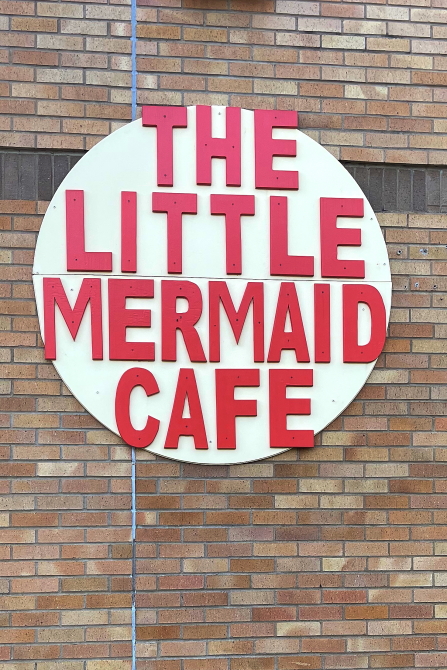
Located adjacent to the museum is The Little Mermaid Café that has a mermaid on the exterior wall of the building and I was told that on the inside of the building there is a wooden statue of the Little Mermaid statue that is located in Denmark.
The Snake River Fur Post in Pine City (population 3,130) is open during the summer months and contains exhibits telling the area's history, including Ojibwe Indian tribes, French voyageurs, and British fur traders. In the visitor center there is a 24-foot birch canoe that was crafted after the 18-century canoes used by the voyageurs.
Located in Voyageur Park adjacent to the Snake River, there is a voyageur statue that was carved from a 42-foot tall redwood log. Since there are no redwood trees in this part of United States, people often ask where the redwood log came from and how it ended up in Minnesota.
Apparently, in the 1940s, the 42-foot redwood log was purchased in Anoka, California, and shipped to Minnesota as a restaurant tourist attraction. At over 7-feet in diameter, the log was much larger than anything most Minnesotans had ever seen, so people would stop by the restaurant just to have their picture taken by the redwood log.
After a few years, the redwood log traveled around the state as an exhibit and finally ended up at a lumber yard in Isanti, Minnesota. Sculptor Dennis Roghair, a three-time world chainsaw champion wanted to purchase the log, but the lumber yard would not sell it. Finally, in 1991, the lumber yard agreed to donate the log as a $20,000 charitable donation to what is now known as the Snake River Fur Post. The local residents raised $26,000 and hired Roghair to carve the statue. The statue was completed on November 3, 1992 and is the largest redwood sculpture in Minnesota. "Francois" is the official name of the statue.