Friday, January 12, 2024

RonnieAdventure #0601 - South Carolina's Kings Mountain, Spartanburg, and more

Kings Mountain National Military Park in South Carolina is only a few miles southeast of Bowling Springs (North Carolina), so one afternoon when Ashley did not have classes we toured the park. 

I did not realize the importance of this battle in the Revolutionary War until we visited the site and watched a movie in the visitor center.

In 1780, the war was at a stalemate in the north; so the British decided to assemble troops in the southern royal colonies and then march north to help the northern troop attack the Patriot forces from two sides. 

On May 29, 1780, while assembling British troops in the south, British Col. Tarleton found a group of 400 Virginia Patriots near Waxhaws, South Carolina, and quickly overpowered them. The Patriots raised a white flag to surrender, but Tarleton ignored the white flag and slaughtered 113 Patriots, maimed over 100 and left them to die on the battlefield, and took the rest prisoners. This infuriated the Patriots. Tarleton was nicknamed "Bloody Ban" and the Patriot's cry for revenge was "give the Tarleton's quarter."

Also in South Carolina at this time was Major Ferguson. Ferguson was inventor of the Ferguson rifle that was more accurate and far superior to the American Long Rifle used by the Patriots. Using the Ferguson rifle, Major Ferguson was the best marksman in the British Army. Once he had the opportunity to shoot George Washington at close range, but before he could get off a shot, Washington turned around and Ferguson refused to shoot him in the back. 

In September, Ferguson sent a message to Patriot leader Col. Shelby of the "backwater men" that if he did not surrender, he would "hang their leaders, and lay their country to waste with fire and sword." He also said that he would kill all of the people living in the area. People in the south were enraged. They were so upset over his comments that many who had been neutral on the war, suddenly joined the Patriots in great numbers and vowed to finish Ferguson once and for all. A large number of Patriots started tracking Ferguson, but spies tipped off Ferguson that a growing number of men were pursuing him. Ferguson then headed for Charlotte where there were British troops to protect him. 

On October 6, 1780, Ferguson and his men camped atop King Mountain, where he decided to stay and wait for the Patriots rather continuing his march to Charlotte. King Mountain was the high point in the area, so Ferguson was confident he had an excellent position to defeat the Patriots. 

On Saturday, October 7, the Patriots arrived and surrounded the mountain. Instead of charging up the mountain as Ferguson expected, the Patriots used guerrilla tactics. They hid behind trees as they advanced, which made them difficult for the British troops to see. On the other hand, the British troops were easy targets because they were standing silhouetted against the sky. Ferguson and most of his troops were killed during the battle. This was a devastating loss to British General Cornwallis because it weakened his entire left flank. On October 19, 1781, Cornwallis surrendered to George Washington at Yorktown, ending the American Revolutionary War.

Ashley and I hiked to the top of Kings Mountain to see the markers along the way and the large obelisk at the mountain top.


Col. Patrick Ferguson (1744-1780)

Col. Frederick Hambright
Lt. Col. James Hawthorn

Landrum (population 2,481), South Carolina, is a few miles south of the North Carolina border. Starting in about 1760, the area was settled by homesteaders from Pennsylvania, Maryland, and Virginia. As homesteaders kept arriving, Earl's Fort was built in the area to help defend settlers against frequent Indian attacks. Nothing remains of the fort today.

Linda's favorite thing in Landrum was the Cousins Maine Lobster food truck parked by the side of the road. I failed to get a picture of the truck, but I did get a picture of the Lobster Roll container. 


Spartanburg (population 38,732) is included in the 10-county region in northwestern South Carolina known as "The Upstate."  In the heyday of railroads, Spartanburg was called "Hub City" because a large number of railroad tracks radiated from the center of town in the shape of a wheel hub. 

Spartanburg is now the headquarters for Denny's restaurant chain, KYMCO, Smith Drug Company, Advance American Cash Advance, American Credit Acceptance, Upward Sports, Milliken & Company, and there is a BMW automotive manufacturing facility located just to the west in Greer. The automotive plant produces about 1,400 BMW vehicles per day. 

Morgan Square in Downtown Spartanburg contains a variety of historic buildings, businesses, restaurants, and art works. We had planned to stay in Spartanburg longer, but we ran out of time and we wanted to get back to Boiling Springs before dark. 


"Chaser" was considered to be "the smartest dog in the World." She was a member of the Pilley family and a research assistant to Dr. John W. Pilley, Jr., Professor Emeritus of Psychology at Wofford College in Spartanburg. Chaser learned to identify over 1000 objects, the largest tested vocabulary of any animal on the planet. When asked about Chaser's learning abilities, Dr. Pilley replied "All creatures can learn and if learning does not take place, we must change the methods."


This hand sculpture represents "I Love You" in American Sign Language. It was created by students at the SC School of the Deaf and the Blind, along with citizens of Spartanburg. 


On the way back to the hotel, I had to stop and take a picture of the Gaffney (population 12,764) water tower - It was painted like a giant peach. Gaffney is known as "The Peach Capital of South Carolina."


Friday, January 5, 2024

RonnieAdventure #0600 - G-Webb, Earl Scruggs, Flag Museum, Pearson's Falls, NC

Just before Thanksgiving we spent part of 10 days visiting granddaughter Ashley at Gardner-Webb (G-Wegg) University in Boiling Springs, North Carolina. It was a great trip and while we were there we also had the opportunity to visit a number of places on my bucket list. 

Ashley is a junior at G-Webb and has a scholarship to play basketball on their Division 1 team. We toured the campus and were able to see one home game in Boiling Springs, and away games at NCU in Charlotte and College of Charleston in South Carolina.


Shelby (population 21,918) is just a short distance from Boiling Springs and is named after Colonel Shelby, a hero of the American Revolution Battle of Kings Mountain (1780). The historic courthouse located in downtown Shelby has now been converted to the Earl Scruggs Center. 

Scruggs was originally from the Shelby area and is known as the person that started the three-finger style of banjo playing. He and Lester Flatt together recorded over 50 albums and 75 singles. Their popular song "The Ballad of Jed Clampett" was used at the theme song for the television sitcom The Beverly Hillbillies. 

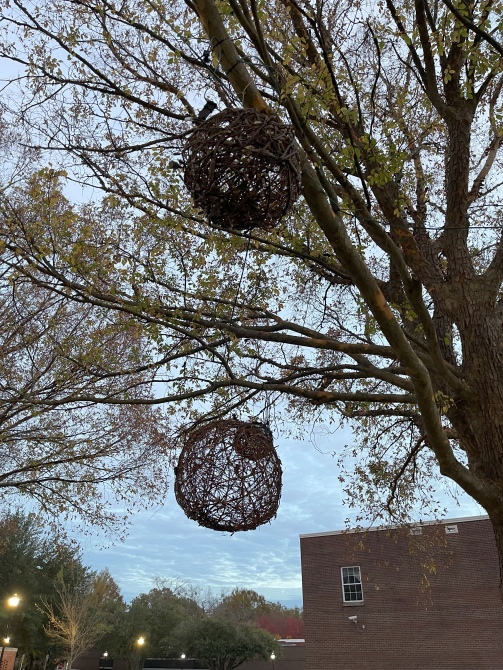
Located by the Scruggs Museum is a war memorial, some unusual tree decorations, several murals, and some nice restaurants. 


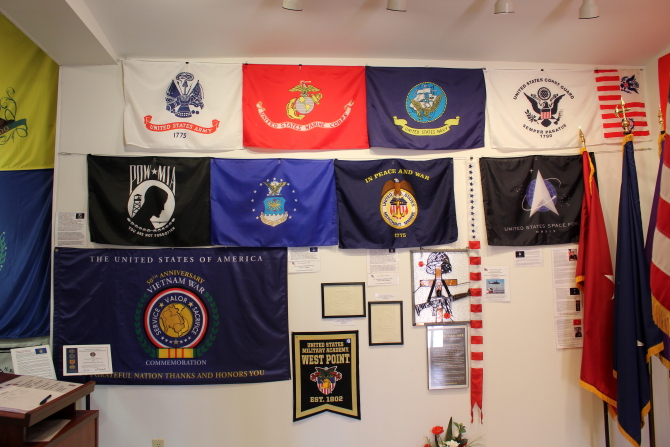
The House of Flags Museum in Columbus (population 1,060) is the only one of its type in America. There are more than 300 United States, military, state, international, and miscellaneous flags in the museum. It is the only museum in the United States with all 27 U.S. flags on display. The museum is divided into five sections - "Defenders of Freedom," "Birth of a Nation," "The Price of Liberty," "Liberty Cap Flags," and "United States of America." We had a very knowledgeable docent that toured us through the museum. 


Stearns Park is located across the street from the House of Flags Museum and contains a gazebo, walking/jogging trail, and several monuments. 


The 20-foot tall Howard Monument obelisk commemorates the 1776 Battle of Round Mountain, which was just northwest of town. In 2007, the monument was disassembled at the battlefield and relocated to Sterns Park to protect it from vandalism. 


Pearson's Falls and Glen is located along Colt Creek, just west of Tryon. The falls and 268-acres of land are owned by the Tryon Garden Club in order to preserve the unique mountain glen. 

In addition to the plants, the glen is a wildlife and bird sanctuary. College and university students frequently hold field trips to this area to study the botany and biology of the plants, animals, and birds found in the canyon. A brochure states that the glen contains over 200 species of rare flowers and plants, along with various types of ferns, mosses, lichens, shrubs, and trees.  

From the trailhead, it is an easy hike to the falls along a beautiful trail that generally parallels the creek. Pearson's Falls is 90-foot tall. 


On May 21, 1540, Spanish explorer Hernando de Soto arrived in the Cherokee Indian village of Xuala, where he was able to trade for supplies. Centuries later, the village of Xuala became what is now known as the community of Tryon (population 1,562). Tyron is located in the Blue Ridge Mountains escarpment, an area known for its outdoor pursuits, equestrian activity, and fine arts.

In the early 1900's, Tryon became a resort for wealthy northerners that came here in the winter months to ride horses and play golf. The Tryon Riding and Hunt Club was formed in 1925 and the club started a Horse Show and Steeplechase in 1929 and 1934, respectively. At its heyday, in 2010, the Horse Show was so popular that schools closed and many businesses closed in the afternoons. 

In 2014, the $100 million Tryon International Equestrian Center (TIEC) opened on 1400-acres of land just outside of town and features 10 riding arenas with a 6,000-seat stadium, 1,000 permanent stalls, elevated viewing decks, hotel, sports complex with health club, tennis courts, mountain bike park, climbing walls, basketball courts, and swimming pools. In 2016, TIEC hosted the World Equestrian Games.

"Morris," the town symbol, is a large version of toys made by Tryon Toymakers and Woodcarvers. Since 1928, Morris (rebuilt and replaced several times) has served as a billboard during the annual Tryon Horse Show and Block House Steeplechase Races. 


There is a statue of Nina Simone just south of Morris. Nina was a world-famous musician that was born in Tryon in 1933 and had a lengthy list of accomplishments.  

Located in the same park is one of the original boundary markers used in the 1767 Cherokee Boundary Treaty to divide the Native American lands from the European settlements.


I liked the movie theater billboard!