Sunday, January 27, 2013

RonnieAdventure #0038 – LBJ Ranch, Gillespie County, Texas

On a recent visit to Texas I stopped by the LBJ Ranch for a tour of the “Texas White House” during the Johnson administration; and much to my surprise, I couldn’t believe that the “Ranch” was a long, narrow strip of land containing only 1,570 acres. Why in Nevada, we call that a garden plot!

Most of the Ranch consists of a fenced airstrip for landing what LBJ referred to as "Air Force One-Half,” a Lockheed VC-140 JetStar that carried passengers between Austin (50 miles to the east) and the Ranch near Johnson City. In 2010 someone found the JetStar in an Air Force salvage yard in Tucson, so they had the plane refurbished and shipped to the Ranch where it is now on display.

There are a number of buildings on the Ranch that are available for viewing on a self-guided tour, including the LBJ Birthplace (reconstructed), the Junction School, Sam Johnson Home, the Show Barn, the Johnson Cemetery, the Texas White House (guided tour only), and a number of the Johnson family automobiles. Although LBJ attended the Junction School for a few months when he was four years old, the family moved down the road a bit to Johnson City where LBJ lived until he went to college. It was in the Johnson City elementary school where LBJ learned his 3-R’s – readin, ritin, and rithmetic!

The family home in Johnson City is also open for guided tours by the National Park Service. Two different movies are available for viewing in the visitor’s center -- One movie gives a summary of the Johnson White House years and the other movie (that I did not see) was reported to be about Lady Bird and Texas wildflowers.

Ya-all stayed tuned for some more Texas Adventures!
 
Visitor Center in Johnson City
 
Johnson House in Johnson City
 
"Texas White House" on LBJ Ranch
 
"Air Force One-Half"
 
LBJ's Lincoln Convertable
 
Junction School located on the LBJ Ranch


Friday, January 25, 2013

RonnieAdventure #0037 (Revision 1) - Highway 178, Roadside Geology, Inyo County, California

Fred H. sent me an email that confirms you can't trust everything that you read on the Internet or information that you get from geologists. Fred responded: "I have a book entitled Geology Underfoot in Death Valley and Owens Valley. There are 30 sites each of which gets a chapter with black and white photographs and an explanation. The third chapter discusses your specific spot which is called the Resting Springs Pass Volcanic Tuff. It is a formation of welded tuff. Basically it is gas-rich magma (mostly glass particles or pumice) explosively blown from a volcanic vent. When it hits the earth it is almost fluid-like and flows along the surface. If it is still very hot when it hits the ground, the residual heat melts glass which compacts and welds together (thus the name)."

Thanks for the information Fred!

Wednesday, January 16, 2013

RonnieAdventure #0037 – Highway 178, Roadside Geology, Inyo County, California


While traveling east on State Highway 178, I was amazed at a geological formation that was visible along a road cut about four miles east of Shoshone, California. After taking some pictures at the site, when I returned home I started checking the Internet for information about what caused the unusual black streak through the road-cut rock formation. Much to my surprise, I found various theories on the Internet that varied from “It was caused by Superman when he dove through the Earth’s crust to stop an earthquake” to “It was caused by a meteorite when it struck the Earth.” Usually when I have a question about anything in the Mojave Desert, I always use Shortfuse (Bill Mann) as a reference, but this time I think Shortfuse got it wrong. (Bill has written six books detailing his extensive travels throughout the Mojave Desert and is usually considered a reliable source for anything unusual.)

People often ask how Bill got the nickname “Shotrfuse,” so some explanation may be in order. In the 1950s Bill was one of the few people roaming around the Mojave Desert that had a blasting license, so when the rock blasting business was slow he would take any jobs that were available. He blew up two railroad bridges (he said it was fortunate that he got the right ones), did demolition work, and worked on movie sets. On one movie set the dynamite charges kept going off before the cameramen were ready for the blast, so they started calling him “Shortfuse” and his wife “Dynamite.” The nicknames stuck!

Anyway, Shortfuse calls this the “Perlite Comet” site. He said that one time he picked up some of the black particles and put them in a campfire, but they didn’t burn like coal or pop as perlite does when heated. The rocks shine and sparkle when the sun is shining, but the particles are not black glass or obsidian.  Therefore, Shortfuse concluded that the shining particles are probably something from the perlite family, but maybe some unknown mineral.

When I did my research on the Internet, I found numerous theories about what did or did not cause the black streak. Some people say that the streak was not caused by a comet because comets are made of ice, so the streak would have been white. I also learned that astronomers have concluded that the streak was not caused by a meteorite because meteorites explode or cause a large crater when they collide with the Earth’s surface; thus, meteorites are not able to penetrate the Earth’s crust.  Advocates of the “Superman Theory” insist that this theory must be true because it was documented in a Superman movie. In the movie Lois Lane’s car falls into a crevasse caused by an earthquake in the Mojave Desert, so Superman goes back in time, dives through the Earth’s crust and supports the area under the Mojave Desert so that the earthquake does not ever occur. This looks like the spot in the movie where Superman dove through the Earth’s crust, so Superman advocated are convinced this theory must be true. The last theory investigated was the “Black Hole” theory, which advocates say has visual confirmation because the streak is black.

When I asked a geologist at work, he looked at the pictures and said that it was just an extinct volcanic vent. Well, so much for the Superman and black hole theories!

Thursday, January 10, 2013

RonnieAdventure #0036 – China Ranch, Inyo County, California

China Ranch is an oasis of water and greenery found in the Mojave Desert near Tecopa, California, and a great place to spend a day hiking and exploring the surrounding area. There are numerous hiking trails that start at the China Ranch general store and lead to many unique and fascination places. The geological formations in this area are spectacular, so when visiting the area it requires a large memory card for your digital camera! Parts of several movies have been filmed around China Ranch and if you saw the movie “The Sum of All Fears,” based on Tom Clancy’s book by the same name, this is where they discovered the atomic bomb!


The most popular hiking trails lead downstream from the store toward the old Tonopah and Tidewater Railroad Line (relatively intact in some places), the Amargosa River (a beautiful riparian corridor that empties into the lower part of Death Valley), and a small slot canyon. Each location is worth a hike based on its own merits. This area became internationally famous a few years ago when the U.S. Ambassador to Denmark visited China Ranch and hiked several of the trails.

Although archaeologists have dated human inhabitant bone fragments found in the area back 10,000 years, the first recorded European visitor was in the spring of 1830. A New Mexico horse trader named Antonio Armijo was developing a trail to move horses from California to Santa Fe and the trail he developed  passed by this area. His route later became known as the Old Spanish Trail. The route meandered from waterhole-to-waterhole and was often referred to as “the longest, crookedest, most arduous trail in the west.” This is the trail that Kit Carson followed when he was guiding the Freemont Party from California to Santa Fe. Although modern roads have covered most of the Old Spanish Trail, in many places it is still possible to see wagon ruts that were left by early travelers as they crossed through this area.

In about 1900 a Chinese man named Qu on Sing (aka Ah Foo) moved to the area after working in the Borax Mines in Death Valley for a number of years. He planted date trees and vegetables and raised cattle that he sold to the local miners. Over the years he became very prosperous and the area became known as Chainman’s Ranch. Then, as the story goes, one day a man named Morrison showed up, shot the Chinaman, and claimed the ranch as his own property. (Apparently, the local law enforcement agency did not investigate the death.)

The date trees thrived and the area is now known as China Ranch Date Farm. An informational sign at the store indicates that “the date palm is the oldest known cultivated tree crop, dating back to at least 6,000 B.C. in Mesopotamia (modern day Iraq)…Frequently cited in both the Bible and the Koran, the date palm has long been considered the tree of life in the middle east.” There are many varieties of dates and they vary widely in size, taste, color and moisture content. You can sample and/or purchase a large variety of different dates in the China Ranch general store. 

Throughout the area there are a large number of open mine shafts and pits, some of which are partially fenced and adjacent to the road. The mines in the main canyon leading to China Ranch were collectively known as the Gypsum Queen and between 1915 and 1918 they produced about 100,000 tons of gypsum. The ore was shipped to Los Angeles on the Tonopah and Tidewater Railroad and was used in the manufacturing of plaster. However, the mines were closed in 1918 after two miners were killed when part of the mine collapsed.

China Ranch areas that are open to the public include a general store, a museum, a few rental units, and the hiking trails.  Hiking trail guides are available at the general store. If you visit China Ranch, be sure to try the banana-date ice cream shake!
Road to China Ranch/Part of Gypsum Queen Mine
China Ranch General Store
China Ranch Mass Transit System
"Bottle Trees"
Hiking Trail
Canyon Hike
Lost Tourist Vehicle
One of numerous arches
Picture by Kolohe
Picture by Kolohe

Saturday, January 5, 2013

RonnieAdventure #0035 – Dublin Wash, Inyo County, California

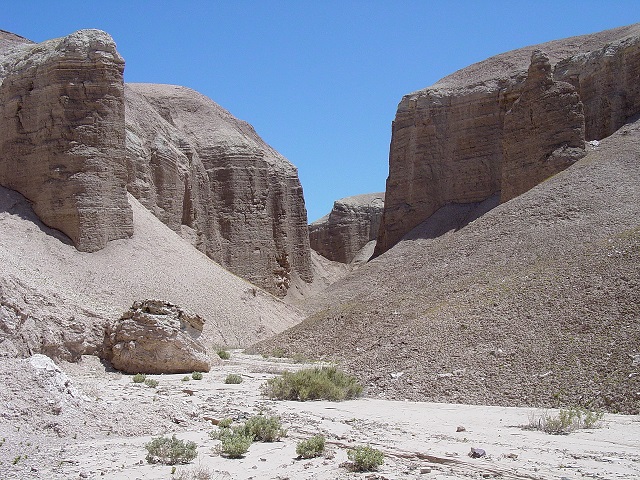
It is not easy to find building materials when you live in the desert, so early miners in the Shoshone, California area decided to build an “underground” city by excavating room in the walls of the local washes. This area is ideally suited for such underground dwellings because there is a hard tufa cap that covers a soft volcanic ash that is easy to excavate. The largest concentration of rooms is located in Dublin Wash, just west of the Shoshone Cemetery in Inyo County, California. If you drive up (west) Dublin Wash, you can't miss the area -- just look for the large number of old rusty cans scattered about the area in front of the rooms.

There are many different versions of who built the first rooms and when the rooms were excavated, but the most plausible story seems to be that the first rooms were dug by Irish miners in the mid-to-late 1800s; hence, the name “Dublin Wash” or “Dublin City.”

The rooms are reported to be warm in the winter and cool in the summer, which is nice for year-round habitation.  Over the years the rooms were enlarged and many rooms were interconnected to accommodate growing families. In later years, some dwelling units were equipped with luxury items like stoves, stove vent pipes (still in existence), and ice boxes. However, when the mines played out, the miners deserted the area and the rooms were abandoned. The local residents report that after World War II the rooms were occupied by a less desirable crowd, but they too abandoned the rooms after a few years and left the area. The rooms are now vacant and it is a fun place to visit.

Since most of the washes surrounding Shoshone have similar soil types, over the years the underground room concept became popular and today vacated rooms can be found in numerous washes in the area. The other well-known area for rooms is located on the north side of California State Highway 178, adjacent to the east side of the Amargosa River. This area is called “Castles in the Clay," and one set of rooms were reportedly developed by Chief Tecopa; however, some local residents discount the story and think the rooms were just developed by other miners. The day we visited “Castles in the Clay,” someone had cut down the large trees that were in front of the “Chief Tecopa” rooms (historic photos show large trees by the entrance) and the door to the rooms was locked. You can't miss this set of rooms because they are very close to the highway and the only set of rooms that have a side window.

Also located at the mouth of Dublin Wash is the Shoshone Cemetery. This is an interesting historic cemetery with many unnamed grave sites marked only with old wooden crosses or just piles of rocks. Although some grave sites have been fenced, this is one place where the grass is definitely not greener on the other side of the fence! Of course, there is no grass on either side of the fence and there is very little vegetation of any type around the cemetery. May the residents rest in peace!

Dublin Wash/"Dublin City"

Dublin Wash/"Dublin City"
 
 "Castles in the Clay"
 
"Castles in the Clay"/"Chief Tecopa Rooms"

Shoshone Cemetery
 

 Shoshone Cemetery
 
 Shoshone Cemetery

Sunday, December 30, 2012

RonnieAdventure #0034 – Pearl Street, Boulder, Colorado

During the holiday season I visited Pearl Street in Boulder, Colorado, with all of the quaint little shops decorated for Christmas and owned by interesting people. While in one shop, I started visiting with the shop owner and I happened to mention that the Christmas lights decorating the trees along the walking mall were very beautiful. She gave me a puzzled look and explained that the lights were not “decorations,” they were “tree warmers.” I must have looked puzzled, because she explained that trees are very fragile and they need tender, loving care to survive. She went on to explain that the reason people all along the mall were hugging trees is because the temperature was below freezing that evening and the people were afraid that the trees might get cold and die. Apparently, early in the fall there was a sheet posted at the old Court House where one could sign up for half-hour blocks of time to hug a tree all night, but this year there were so many applicants that wanted a time slot, all of the spots for the entire winter were filled within the first few hours of the posting. Next year, to have more equality, they plan to have a lottery to give more people a chance to get a time slot. (It should be noted that not everyone in Boulder is eligible to sign up for these openings or enter the lottery next year. To be eligible, applicants must have demonstrated previous tree hugging experience or have a PhD in Tree Hugging from CU or UC Berkeley.)

Because of my lack of knowledge about tree hugging, the woman must have suspected that I wasn’t a local and asked me where I was from. When I said “Nevada,” she gasped and asked how we managed to survive in such a hostile environment with no trees. She said that her family had never been to Nevada because they were afraid that without trees, there would be a lack of oxygen and they wouldn’t be able to breathe. I said that it wasn’t any different than in South Dakota where I grew up. However, I explained that when I lived in South Dakota we had tumble weeds that grew to be the size of trees. As a matter of fact, the tumbleweeds along the farm fences were so large that we had to cut them down with an ax. She looked a little skeptical, but continued the conversation by asking if we had ever tried planting any trees to produce more oxygen. I told her that one time when I was a kid I did plant a tree, but my brother thought that it was a tumbleweed and drove over it with a tractor. She said that was the saddest story she had ever heard and then burst into tears and started sobbing!

As I started to leave, she said that she had enjoyed our visit and she could see in my eyes that I was a kind person and would make an excellent tree hugger. She then told me that her family was part of the Chipko Movement and planned to attend the annual convention to be held in the Garhwal Himalayas of Uttarakhand next summer. She said that tree huggers from all over the world would be there and I should bring my family and attend the conference. I burst into tears and started sobbing!


Friday, December 21, 2012

RonnieAdventure #0033 – Peoples Canyon, Yavapai County, Arizona

When I received an invitation from the property owner to accompany him and several other people on a trip through Peoples Canyon in northwest Arizona, how could I decline the offer! Peoples Canyon is a privately owned in-holding within the Arrastra Mountain Wilderness Area, surrounded by State and Federal lands; thus, permission from the land owner is required to make this hike.

The weather was projected to be clear and sunny with temperatures in the mid-to-high 70s -- What a great time for a RonnieAdventure! Since a number of people were invited on the outing, it was decided to meet at a small dirt trail that runs west from US Highway 93 about 30 miles south of Wikieup. I was the only one that had not previously made the hike, but I was assured that the dirt trail was easy to find.

The morning of the hike I arrived in the general area about 15 minutes late and, of course, could not find the dirt trail or any of the other hikers. I decided that I needed to travel a little farther south, so I continued on my journey but did not find a dirt trail until I had traveled about five miles. Then, when I did locate a dirt trail, it was blocked by a locked gate. I continued searching the area, but no other dirt trails could be found. So, I presumed everyone must have left without me and decided to head for home.

As I passed the original area where we were to meet, I happened to notice some vehicles parked in a dry wash about 500 feet distant from the highway. Instinctively, I turned around and noticed a small dirt trail leading to the dry wash that was partially concealed by Palo Verde Trees, which kept me from seeing the dirt trail the first time I passed by the area. Traveling down the dry wash, I found everyone waiting for me, wondering where I had been. So much for meeting by the highway!

Fortunately, I was driving a Chevy Blazer because the three miles from the highway to the trail head was over a really, really nasty dirt trail that required a high-clearance 4-WD vehicle. We decided that from the wilderness boundary trailhead we would make about a five mile hiking loop that would enter Peoples Canyon about a mile upstream from the springs we were looking for so that we could see some Native American pictographs painted on the ceiling of a cave.

The trip through the canyon was spectacular and we were surprised at the amount of water flowing from the springs in mid-December. The only bad thing about hiking to the springs was that it was all downhill from the trailhead, so the trip out was all uphill! However, the hike out was very enjoyable because Peoples Canyon is located in the Sonoran Desert, which has substantially different plant materials than the Mojave Desert around Las Vegas.

Except for scraping the bottom of the vehicle on a few rocks on the way out, and adding some desert pin-stripping to the paint job, the trip home was uneventful. Now, I just have to return again when I have more time to explore the surrounding area.
 
Trail to Peoples Canyon
  
Peoples Canyon
  
Native American Pictographs
 
Peoples Canyon
 
Peoples Canyon
 
Peoples Canyon
 
Peoples Canyon
 
Peoples Canyon
 
Peoples Canyon
 
Peoples Canyon
 
Staghorn Cholla Cactus
 
Hiker On Trail Out / Saguaro Cactus
 
Palo Verde Tree
 
Prickly-Pear Cactus